
I approach each artwork as an unexplored trail, obscured by darkness. The destination is unknown, and I can only see a few feet ahead. I may carry specific materials or an initial sense of direction, but the path remains undefined. Along the way, alternative routes may emerge, leaving me to wander somewhere unexpected. By remaining curious and adaptive, I navigate the process instinctively, guided by prior knowledge and experience. Eventually, looking back, it becomes clear that it was never solely about the destination, but the experience of the journey itself. This curiosity, willingness to wander, and openness to uncertainty are essential to my creative process as a dark artist.
The foundation of my workflow exists between conscious thought and unconscious action. Each artwork is constructed through a balance of intuitive gesture and controlled refinement, creating a duality that combines emotional expression with technical precision. By embracing uncertainty and imperfection, each piece remains open to unexpected developments. I typically begin either without a predetermined concept, allowing imagery to emerge organically, or with a preparatory sketch that is gradually manipulated and reconstructed as the work evolves.
My artistic practice employs experimental combinations of expressionism, impressionism, surrealism, abstraction, and academic influences, constantly seeking innovation and evolution. Different moods, techniques, and mediums breed a variety of imagery. I draw from places of introspection, reflection, and observation, seeking to create personally honest work. Using artmaking as a form of self-regulation and catharsis, subjects often carry darker undertones, addressing psychological, emotional, and unconventional themes. By engaging with dark and strange subject matter, I aim to better understand personal experience while creating space for connection with others.
Drake Zappa is a multidisciplinary dark artist from Pittsburgh, PA with a background in Art History, Psychology, and Carpentry. His work moves across a diverse range of visual styles and subject matter, shaped through experimentation, transformation, and reinvention. Working across multiple disciplines allows him to continually explore new materials, techniques, and approaches, with each area of his practice informing and influencing the others.
As a dark surrealism artist, his work moves between intuitive action and deliberate construction, drawing on the relationship between conscious thought, personal experience, imagination, and instinct. His practice navigates themes of emotional intensity, introspection, and psychological landscapes.
Rather than being confined to a singular aesthetic, his practice uses a flexible visual language in which style is determined by concept rather than convention. His work encompasses surreal and dreamlike imagery, distorted proportions, macabre symbolism, horror-inspired imagery, abstract compositions, and expressive explorations of form.
As a dark artist, he draws from Expressionism, Surrealism, Classical drawing and painting, abstraction, and impressionistic sensibilities. These influences converge in a visual language that often moves toward Dark Expressionism, while remaining fluid between representational and non-representational approaches. This stylistic versatility allows each work to establish its own visual identity while remaining connected by an enduring fascination with the emotional, transformative, and psychological dimensions of the human experience.
I explore the boundary between external reality and internal experience as a dark surrealism artist. My imagery often begins with subjects that are familiar, tangible, and rooted in the observable world, yet they rarely remain unchanged. Subjects such as isolated spaces, solitary figures, dreamlike landscapes, symbolic motifs, and hidden imagery become starting points for surreal, psychologically charged compositions. Through subconscious association, expressive gesture, and intuitive transformation, forms become distorted, fragmented, exaggerated, and organic, suspended between memory, dreams, and waking consciousness.
While classical surrealism often embraces the bizarre and irrational, my work draws from these qualities while focusing more heavily on the psychological weight of the macabre, horror, and the grotesque. These elements construct worlds that are unsettling and surreal, while also reflecting internal states that may be difficult to express through literal representation. The darkness within my work is not simply intended to shock, but to create an immersive space where discomfort, vulnerability, and unbconscious thought can exist together.
As forms and imagery reveal themselves, they become subject to conscious reflection and refinement, creating an ongoing dialogue between instinct and intention. This interplay brings underlying themes and psychological motivations into focus, where they can be reshaped and reinterpreted. In this way, my work exists between control and surrender, reality and imagination, and the kn
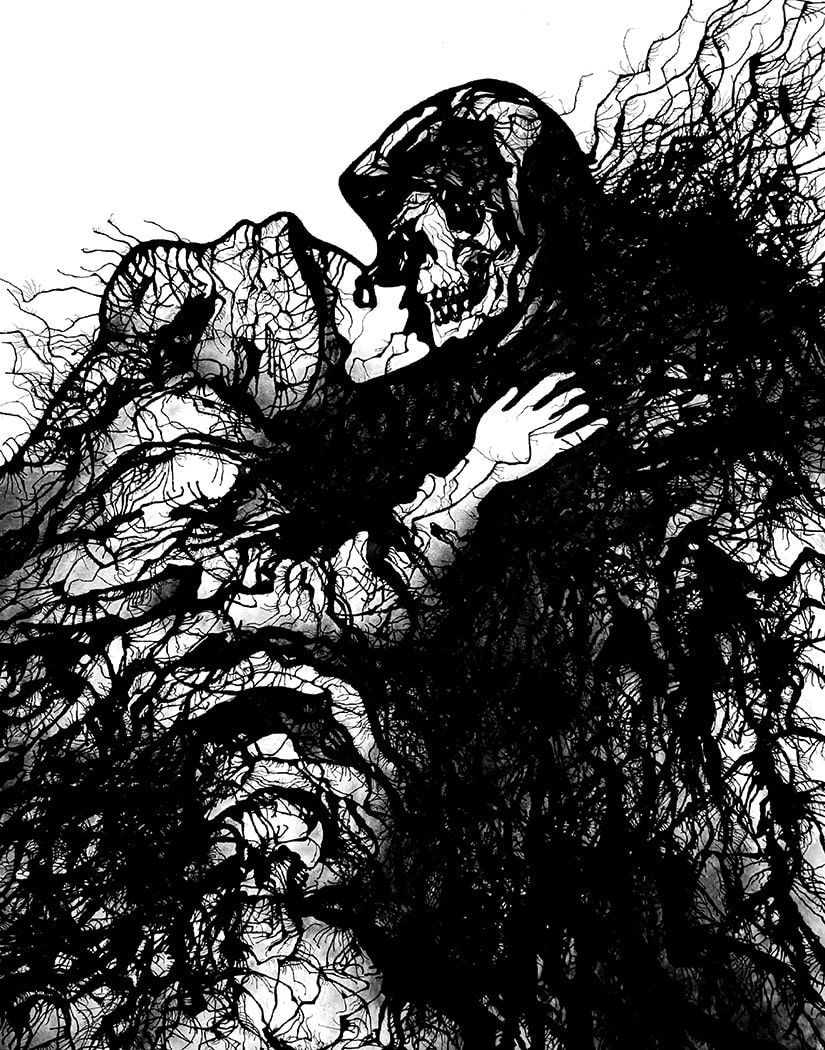
My creative process is rooted in a continuous dialogue between the conscious and subconscious mind, where intuition, experimentation, and deliberate decision-making exist together. Rather than following a fixed formula, I approach each work as an open-ended act of discovery, where the direction of the piece is often revealed through interaction with the medium itself. The material, mark-making, and physical actions of creating become active participants in the development of the image. A single gesture, line, texture, or accidental occurrence can shift the entire trajectory of a work, opening new possibilities that could not have been predetermined.
When creating without a fixed concept, I let imagery gradually emerge through the relationships formed between shapes, marks, colors, and textures. I search for visual connections and emerging forms, following spontaneous associations, experiences, emotions, and intuition to guide each work. Through gradual refinement, abstraction, and deconstruction, these spontaneous beginnings develop into more intentional compositions where instinct and conscious judgment work together.
Beginning with a planned idea or preparatory drawing, I work in reverse. The initial concept provides a foundation, but I subject it to expressive manipulation, distortion, layering, and abstraction. Rather than simply reproducing the reference, I look for new relationships and visual tensions to alter its direction. The final work remains connected to its original intention while becoming something beyond what could have been imagined at the beginning.
My artistic lineage is rooted in a longstanding fascination with the mysterious, the uncanny, and the darker aspects of imagination. Early influences came through childhood encounters with monster movies, horror imagery, creature design, and the haunting illustrations of dark artist Stephen Gammell in Scary Stories to Tell in the Dark, which introduced me to the power of atmosphere, fear, and visual storytelling.
As I developed artistically, I was drawn to dark artists who used distortion, symbolism, and emotional intensity to explore deeper aspects of human experience. Edvard Munch and Francis Bacon influenced my understanding of psychological expression, demonstrating how the figure can become a vessel for anxiety, isolation, vulnerability, and internal conflict. Surrealists such as Salvador Dalí and Max Ernst expanded my interest in dream logic, transformation, and symbolic relationships. The visionary worlds of Hieronymus Bosch, Zdzisław Beksiński, and H.R. Giger further shaped my fascination with the grotesque, the macabre, and imagined realities that exist between fantasies and nightmares.
Additional influences such as Caravaggio, Francisco Goya, Alberto Giacometti, Egon Schiele, and Picasso expanded my understanding of dramatic contrast, expressive distortion, abstraction, and the psychological possibilities of the human form. Across these influences, I am drawn to artists who transform reality to reveal hidden emotional, symbolic, and psychological truths.
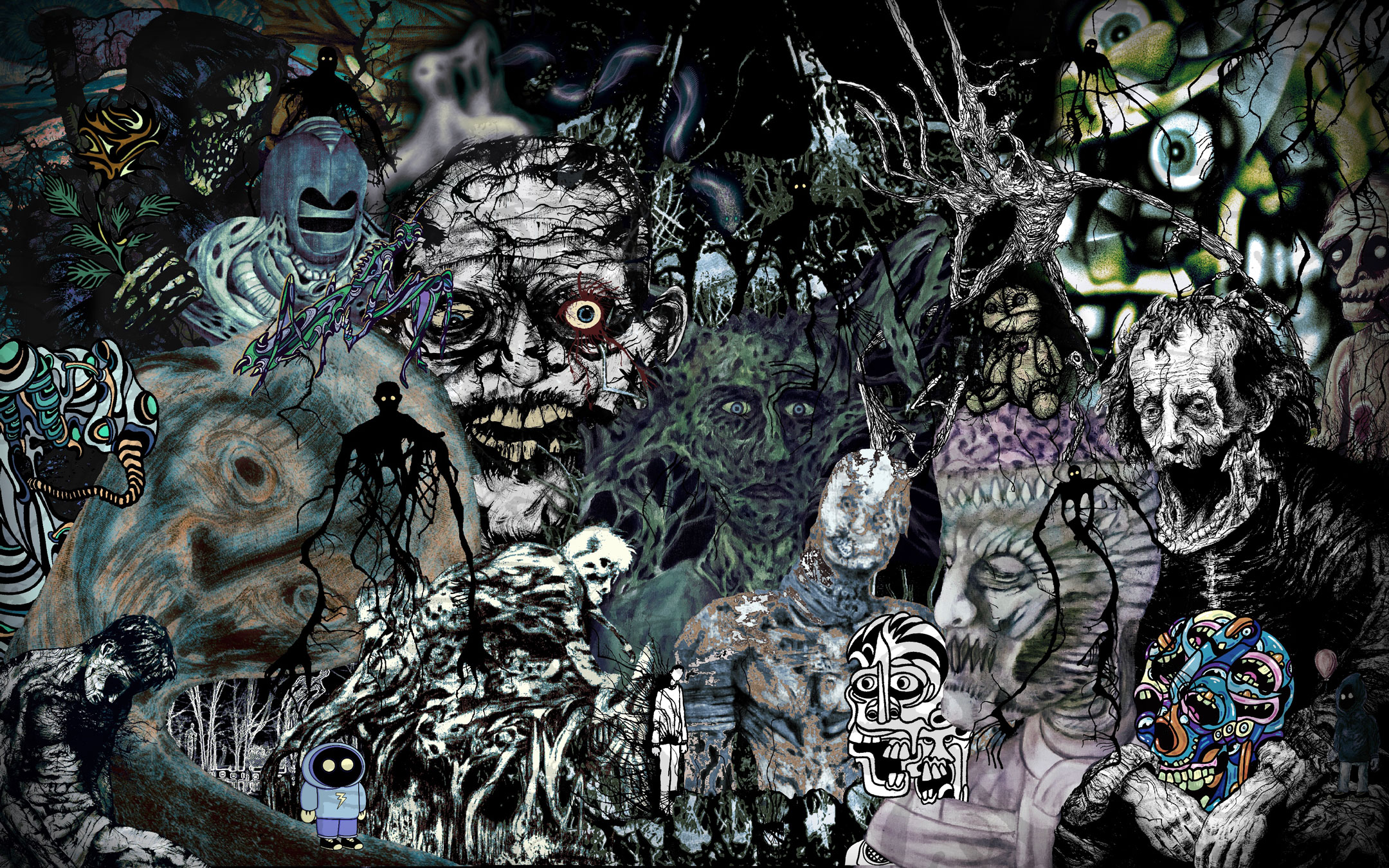
I work across multiple mediums because each discipline offers its own language, limitations, and possibilities. Moving between them challenges me to think differently, solve problems creatively, and approach ideas from new perspectives. Learning to navigate these differences continually reshapes the way I think, create, and respond to my surroundings. Working with different mediums such as ink drawing, painting, sketching, digital art, and tattoo design keeps me inspired and prevents creative stagnation.
Experimentation allows me to develop new skills, challenge myself, and discover unexpected ways of bringing imagination into reality as a dark artist. The lessons I learn in one discipline often influence another, creating a continuous exchange between materials, techniques, and ideas.
Although my work takes many forms, it remains connected by a commitment to experimentation, curiosity, and honest self-expression. Each medium presents different possibilities and challenges, and the knowledge gained through one discipline often influences how I approach another. Moving between materials and techniques keeps my practice open while giving me new ways to approach ideas, solve problems, and develop as an artist.
Drake Zappa is someone who enjoys creating through multiple artistic outlets, whether it be art, music, or video. He creates authentic original art that is personally honest, truthful, and emotionally vulnerable in hopes of providing others a space for connection and inspiration.
Drake Zappa is drawn to darker subject matter because it provides a space to explore emotions and experiences that are often difficult to articulate. Creating dark art allows him to process thoughts, feelings, and questions through a visual language, transforming discomfort, curiosity, and introspection into something tangible. Rather than glorifying darkness, he’s interested in its honesty, visual power, and ability to invite reflection.
Drake Zappa’s creative process changes depending on the medium and subject, but it’s always guided by a balance of intuition and intention. Some projects begin with a clear concept, while others start with an interesting shape, feeling, or idea. Most often, he doesn’t know what the finished piece will become. He enjoys watching the work evolve naturally through experimentation and discovery, often embracing the unexpected.
Rather than choosing a specific medium in advance for a piece, Drake Zappa starts with whatever materials he picks up and lets the work unfold naturally. Ideas tend to emerge through making rather than extensive planning, with the medium and intuition guiding the work. For him, creativity is about remaining open to possibilities and freely letting the work develop organically.
Drake Zappa isn’t trying to communicate any specific message through his work. He uses art to explore his thoughts, emotions, and experiences, searching for truth, meaning, and understanding in a way that feels honest. Ultimately, he hopes that sharing this exploration can create connection, encourage reflection, and give others space to engage with the artwork.
You can follow Drake Zappa’s work across the social media platforms linked on the homepage or search for his name. I also go by @dzdrawz on several platforms as well.
For updates on new original artwork, prints, limited releases, local events, and other announcements, you’re welcome to join his newsletter.
If you’d like to collaborate, commission a piece, discuss a project, ask a question, or just say hello, don’t hesitate to reach out. His inbox is always open through email or direct message.